
The importance of investigative journalism in exposing abuse
The recent reporting concerning David Walliams and Russell Brand is a reminder of the importance of, and indeed the debt gymnasts and their parents owe to, investigative journalism in exposing abuse of all kinds.
Abuse rarely comes to light simply because the organisations responsible for preventing it decide to expose their own failures. More often, it takes the persistence of victims, whistleblowers and investigative journalists to bring the truth into the public domain, frequently in the face of threats of legal action.
Investigative journalism can provide the platform that allows people to speak, connect experiences that have previously been treated as isolated incidents, challenge institutional accounts and ask questions that those in positions of power might prefer not to answer. Think also of the Post Office and other similar scandals.
It also plays a vital role in enabling victims, hitherto silenced, to come forward uncovering information that might otherwise have remained hidden.
This was never truer than in the world of gymnastics
Nassar
In August 2016, The Indianapolis Star published an investigation into the way USA Gymnastics handled allegations of sexual abuse. The article did not initially focus on Nassar himself. However, it prompted former gymnast Rachael Denhollander, who had been waiting for an opportune moment, to contact the newspaper. She explained that she had been abused by Nassar and that her experience might be relevant to the journalists’ investigation. Her willingness to speak to the newspaper helped lead to the publication, in September 2016, of the first major report specifically exposing allegations against Nassar. Before this, gymnasts who tried to report Nassar had been ignored or even punished and forced to apologise.
Denhollander became the first woman to publicly accuse him. Other survivors subsequently came forward, and the scale of the abuse became impossible to ignore.
It is worth reflecting on what might have happened had Denhollander not seen that original article, or had she not felt able to contact the journalists. How many more years might Nassar have continued to abuse young athletes? How many other survivors might have remained silent, believing their experiences were isolated or that nobody would believe them?
From UK 2020…
The British gymnastics scandal provides another powerful example of the role of journalism. In July 2020, ITV News broadcast Beaten and Starved, exposed allegations of physical and emotional abuse within British gymnastics. Significant further reporting from BBC Sports, The Guardian, and many others all helped create the space for other gymnasts to speak publicly about their experiences. Their accounts, alongside those of many others, brought wider attention to practices that had too often been normalised or dismissed as just part of the demands of sport.
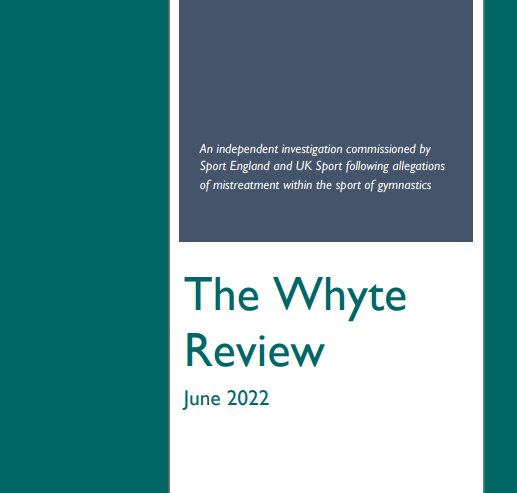
The subsequent Whyte Review received more than 400 submissions and involved 190 interviews. Its 2022 report concluded that physical and emotional abuse had been systemic within British gymnastics and that gymnast welfare and wellbeing had not been at the centre of British Gymnastics’ culture.
Survivors, campaigners and others had been raising concerns for years. But it was investigative journalism that played a vital role in bringing those concerns to a much wider audience and creating sufficient pressure for an independent examination of what had happened to be commissioned.
Through to today…
Importantly, the role of journalism does not end when a scandal is exposed, or an independent review is published. It is just as important to scrutinise what happens afterwards. For example, whether recommendations are implemented, whether promised cultural changes reach individual clubs, whether complaints are dealt with fairly and effectively, and whether children are actually safer.
Two very recent examples demonstrate why that continuing scrutiny matters:
In October 2026, Suzanne Wrack’s reporting for The Guardian, “The sexual assault scandal rocked gymnastics – but has pace of change in the sport been too slow?”, revisited the Nassar scandal ten years after the Indianapolis Star investigation. Speaking to survivors and advocates at the World Championships in Rotterdam, Wrack examined the response and the concerns that meaningful change has been too slow. The article highlights continuing experiences of physical and emotional abuse, the isolation of athletes, weaknesses in complaints processes and the frustration of survivors and advocacy groups who feel they are not being properly involved in reform.
In November 2026, Sarah Dawkins and Melissa Sharman’s BBC Sport investigation, “’A smack in the teeth’ – warned coach to work at international youth event” , provided another example of the need for continued scrutiny. The journalists examined documents relating to investigations into concerns about fear-based coaching, emotional harm, controlling and restrictive practices and punitive attendance policies at a British gymnastics club. British Gymnastics had upheld a number of concerns and issued the coach and club with a two-year formal warning, alongside monitoring and development measures. Yet the coach was selected to work with the English team at an international competition for junior and pre-junior gymnasts while the investigation was still ongoing.
The BBC’s reporting also highlighted the frustration of complainants, including those who said they had not been told which specific concerns had been upheld. It raised questions about the effectiveness of repeated training and warnings where concerns have been raised over a number of years, and about the lack of public information available to parents.
In the absence of any real scrutiny and oversight in sport – these are precisely the kinds of questions that investigative journalism needs to ask. It is not enough for a governing body to announce new policies, training programmes or safeguarding initiatives. We need to know what happens when concerns are raised, what action is taken, whether that action is effective and whether the same problems continue to arise. We need to know whether the interests of children are genuinely being prioritised, rather than simply being assured that safeguarding is a priority.
Of course, it shouldn’t have to be this way, but until now there seems to have been very little progress in ensuring that there is meaningful scrutiny of sport, dance or other out-of-school settings for children. There is still no Sports Ombudsman for example despite Baroness Tanni Grey-Thompson first recommending creating a government-backed, independent Sport Ombudsman in her April 2017 Duty of Care in Sport review for the UK government.
Until more is done to safeguard children (and adults) in sport, it seems we will have to continue to hope for the assistance of busy journalists when whistle blowers continue to be silenced and isolated. Allegations must be reported responsibly, the responses of those accused must be fairly represented, and allegations must not be presented as proven findings. But journalism has a distinct and essential role: it can uncover patterns, expose contradictions, give survivors a voice and hold powerful people and organisations to account.
Without investigative journalism, many of the stories that have changed our understanding of abuse in sport might never have been heard. And without journalists continuing to ask difficult questions, there is a real risk that the public will be told that things have changed while the experiences of children inside those systems tell a very different story.