Who ‘Owns’ Your Child Gymnast?
We are dismayed to see an old rule re-emerging in British Gymnastics’ new Standards and Expectations policy.
“Talk with your gymnast’s coach and the club before trialling … with another coach or at another club—even if it’s in a different discipline.”
Superficially, this may sound like basic etiquette. But this newly articulated expectation has a long and troubling history, and the implications of reviving it should have been clear to anyone who understands that the single greatest factor at the heart of abuse in gymnastics is the propensity for a potentially dangerous imbalance of power to develop.
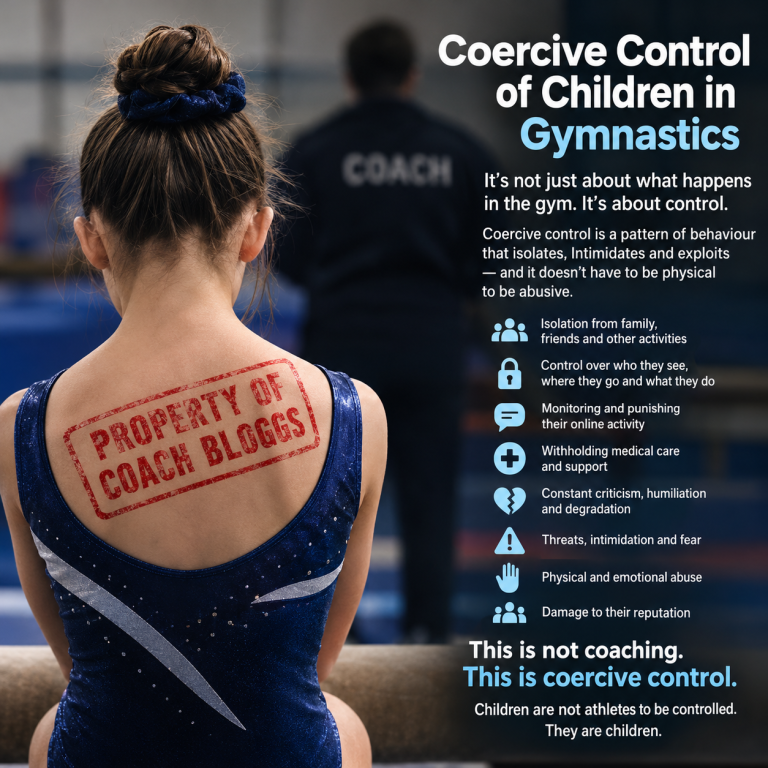
As gymnastics becomes increasingly important to a child, it doesn’t take long for their entire sense of identity and self-worth to become dependent on what happens in the gym. With that, their coach’s power grows exponentially while that of their parents’ diminishes. As the coaches control grows, parents may feel they have little choice but to comply with a coach’s demands, particularly when challenging them seems likely to jeopardise their child’s wellbeing. For children who are already vulnerable, this power imbalance can make speaking out difficult, reporting concerns frightening and leaving a harmful environment feel almost impossible. As the Whyte Review describes, it isn’t uncommon for gymnasts to both worship and be terrified of their coaches in equal measure.
The old rule: treating children as club property
For many years, children wishing to leave a club needed a signed release from that club. The system was not unlike a professional football transfer, treating gymnasts almost as though they were owned by their clubs.
If a club refused to sign, a gymnast could be prevented from competing for their new club for a year, while the receiving club could come under considerable pressure and even sanctions.
It went further. Children were expected to obtain permission from their existing club to trial or even visit or talk to another. If they approached another club without permission, that club was obliged to contact their current club immediately to ‘tell on them’.
Gymnasts were frequently expelled for daring to trial elsewhere, effectively blackballed from joining other clubs in the region. Even highly talented gymnasts could find themselves with nowhere to go, as powerful clubs threatened smaller ones that might consider taking them on.
This meant that simply exploring the possibility of leaving a toxic club could put a child’s entire participation in gymnastics – a sport they’d grown to love – at risk. Children and parents knew that any attempt to explore alternatives might be reported straight back to their existing club, potentially provoking punishment or expulsion. And even if another club wanted to take them, there was no guarantee it would be willing to risk the consequences.
Think about what this means for a child who is frightened of their coach, who is being mistreated, or whose parents have begun to question what is happening. How freely can that family act if the very person they are concerned about must be consulted before they can explore somewhere else to train?
The rule disappeared but the culture remained
While we were relieved to see this disappear from handbooks as an official rule in recent years, the attitudes underpinning it sadly never went away, and we know many of you will be shouting as you read this that “It’s still the same!”
Clubs still frequently ‘tell on’ gymnasts who approach them, let alone those who actually trial. Meanwhile, toxic clubs and coaches still contact other clubs and coaches to badmouth gymnasts and undermine their chances of moving elsewhere. And it isn’t even about clubs/coaches wanting to keep the gymnast, they might even be actively bullying them out, this is about ensuring that anyone leaving a club or coach isn’t seen succeeding elsewhere.
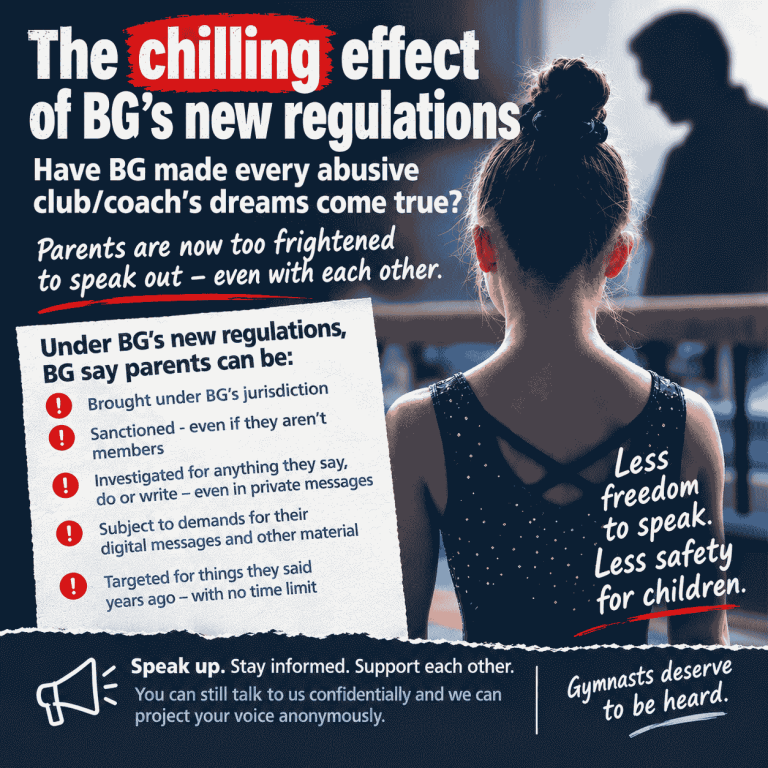
This creates a chilling effect. Gymnasts and parents are deterred from exploring alternatives because they fear repercussions, damage to their reputation or the possibility of being shut out of the sport altogether.
The families most affected may be precisely those who most need the freedom to leave; those whose children are unhappy, distressed, being mistreated or afraid to speak openly about their experiences.
If it is just basic courtesy, why does it need to be a rule?
In healthy clubs with healthy relationships between coaches, gymnasts and parents, communication about a child’s plans will often arise naturally. Families may choose to discuss their options with their existing coach as a matter of courtesy, mutual respect or practical necessity.
But that is very different from embedding an expectation in a national governing body’s policy.
When relationships are healthy, courtesy does not need to be mandated. When relationships are unhealthy, an expectation to consult the existing coach can become a barrier to leaving. And when the governing body claims jurisdiction over parents and can discipline them for falling below its ‘expected standards’, what might otherwise be interpreted as a polite suggestion carries a much greater weight.
Is the risk of reinforcing the idea that clubs have a claim over children really worth taking, simply to formalise a courtesy that should arise naturally in healthy relationships?
We do not believe it is.
There must be a clear distinction between encouraging respectful communication and creating an expectation that a coach or club should be consulted before a family can explore other options. No club owns a child. No coach has a right to control where a child chooses to train, and no parent should have to seek a coach’s approval before looking for a different environment for their child.
By telling parents that they should consult their child’s existing coach and club before trialling elsewhere, BG risks reinforcing the very power imbalance that safeguarding should be working to dismantle
At GymPal, we believe children and their parents must be free to explore other clubs without fear of punishment, intimidation or retaliation. They should not have to risk their child’s future in the sport simply to find somewhere safer, healthier or more suitable to train.
British Gymnastics should be asking how it can reduce the power imbalance that leaves children and families vulnerable—not introducing expectations that could strengthen it.
Children are not club property. Their welfare must come before a club’s interests, a coach’s authority or an expectation of ‘courtesy’.
You can download the new policy here:
https://a.storyblok.com/f/83342/x/cca8dd9783/standards-and-expectations-v1-0-final-restr.pdf